

PSR J2322-2650b: The Bizarre Giant Planet Orbiting a Neutron Star
Discovery and Identification of PSR J2322-2650b
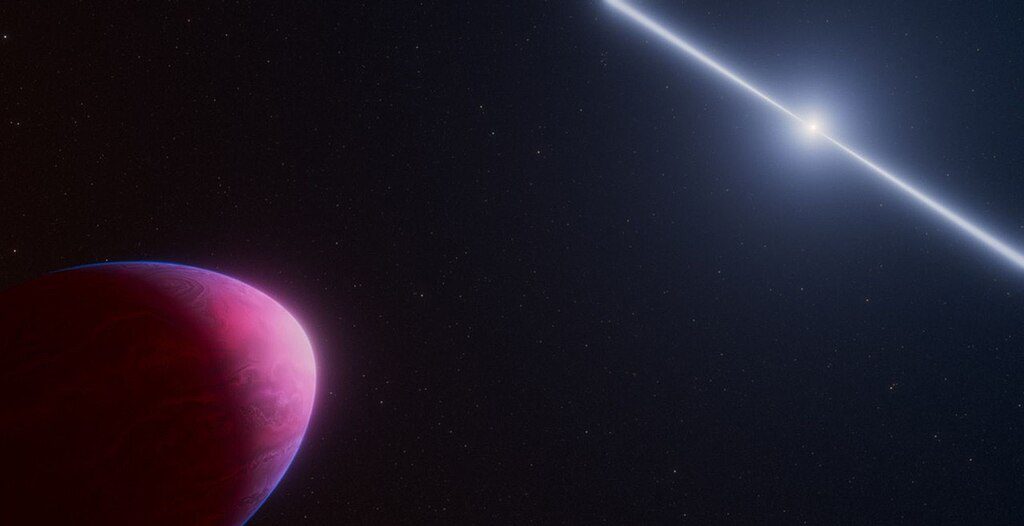
PSR J2322-2650b is one of the most unusual planetary discoveries in modern astronomy and has captured global attention due to the extreme environment in which it exists. Unlike most newly discovered planets, which orbit ordinary stars similar to our Sun, PSR J2322-2650b orbits a neutron star — the ultra-dense, collapsed core left behind after a massive star explodes in a supernova. Neutron stars are among the most extreme objects in the universe, making the existence of a large planet in this system both shocking and scientifically valuable.
The planet was detected using precise pulsar timing techniques. Pulsars emit incredibly regular radio pulses, and astronomers noticed subtle irregularities in the timing of those pulses coming from PSR J2322-2650. These variations revealed the gravitational influence of a massive orbiting body, later confirmed to be PSR J2322-2650b. This method allows scientists to detect planets that would otherwise be invisible using traditional transit or radial velocity techniques.
What makes this discovery particularly noteworthy is that pulsar planets are exceptionally rare. Only a handful have ever been confirmed, and PSR J2322-2650b stands out because of its size, composition, and survival in such a hostile environment.
Size, Mass, and Orbital Characteristics
PSR J2322-2650b is classified as a gas giant with a mass comparable to Jupiter. However, its density and inferred composition suggest it may be rich in heavy elements, possibly including carbon-dominated materials unlike anything found in our solar system. Astronomers believe the planet may have formed from debris left over after the supernova explosion that created the neutron star, making it a true “second-generation” planet.
The planet orbits extremely close to the pulsar, completing a full orbit in just a few hours. This tight orbit exposes PSR J2322-2650b to intense radiation, particle winds, and gravitational forces that would destroy most known planetary bodies. Despite this, the planet has remained stable for millions, possibly billions, of years.
Its unusual orbit also causes measurable effects on the pulsar itself, allowing scientists to study the planet’s mass and orbital eccentricity with remarkable precision. This makes PSR J2322-2650b one of the best-characterized pulsar planets ever discovered.
A Planet Born From Destruction
One of the most fascinating aspects of PSR J2322-2650b is the theory surrounding its origin. Traditional planet formation occurs in protoplanetary disks around young stars. In this case, however, astronomers believe the planet may have formed from the remnants of a star that exploded in a supernova.
After the explosion, leftover material could have settled into a disk around the neutron star, eventually clumping together to form a new planet. If this theory is correct, PSR J2322-2650b represents a rare example of planetary formation after stellar death, fundamentally expanding our understanding of how and where planets can form.
This discovery challenges the long-held assumption that planets require calm, stable environments to develop. Instead, it suggests that the universe may be capable of creating planets even in the aftermath of catastrophic events.
Extreme Conditions and Atmospheric Possibilities
PSR J2322-2650b exists in conditions far beyond anything experienced by planets in our solar system. The neutron star emits powerful radiation beams and high-energy particles that bombard the planet continuously. These conditions likely strip away lighter elements from the planet’s atmosphere, potentially leaving behind heavier gases or exotic molecular compounds.
Some astronomers speculate that the planet could possess an atmosphere rich in carbon compounds, giving it a composition radically different from Jupiter or Saturn. While direct atmospheric measurements are currently impossible, future radio and high-energy observatories may offer indirect clues about its chemical makeup.
The planet’s survival under such conditions makes it an important natural laboratory for studying planetary resilience and atmospheric evolution in extreme environments.
Why PSR J2322-2650b Is Big News in Astronomy
PSR J2322-2650b is big news because it forces scientists to rethink fundamental assumptions about planetary systems. Its existence proves that planets can survive — and possibly form — in places once thought completely inhospitable.
The discovery also highlights the power of pulsar timing as a planet-hunting method. While missions like TESS and Kepler dominate headlines, PSR J2322-2650b reminds astronomers that some of the most extraordinary worlds can be found using unconventional techniques.
As astronomers continue to study neutron stars and pulsars across the galaxy, PSR J2322-2650b opens the possibility that many more exotic planets may be waiting to be discovered in the most unlikely places.
What This Planet Tells Us About the Universe
PSR J2322-2650b demonstrates that planet formation is more versatile and resilient than previously believed. The universe appears capable of building worlds not just around ordinary stars, but also around the remnants of stellar explosions.
This discovery expands the boundaries of planetary science and reinforces the idea that the cosmos is far more diverse than our solar system alone would suggest. PSR J2322-2650b is not just a curiosity — it is a reminder that planets can exist in forms and environments that challenge imagination itself.
Recent Articles Like This One