
TOI-6883Ab: A Giant Exoplanet on a Stretched, Eccentric Orbit
Discovery and Detection of TOI-6883Ab
TOI-6883Ab drew attention in recent exoplanet news because it represents a class of giant planets with unusual and highly eccentric orbits. The planet was first identified using data from NASA’s Transiting Exoplanet Survey Satellite, which detected periodic dips in the brightness of its host star. These signals suggested a large planet passing in front of the star, but follow-up observations revealed a more complex and intriguing orbital configuration.
Ground-based telescopes were used to refine the planet’s mass and orbit, confirming that TOI-6883Ab is a gas giant with a noticeably elongated path around its star. This eccentric orbit sets it apart from many hot Jupiters and highlights the dynamic histories that planetary systems can experience.
The discovery of TOI-6883Ab provided astronomers with another key example of how planets can end up in extreme and unexpected orbits.
Size, Mass, and Orbital Dynamics
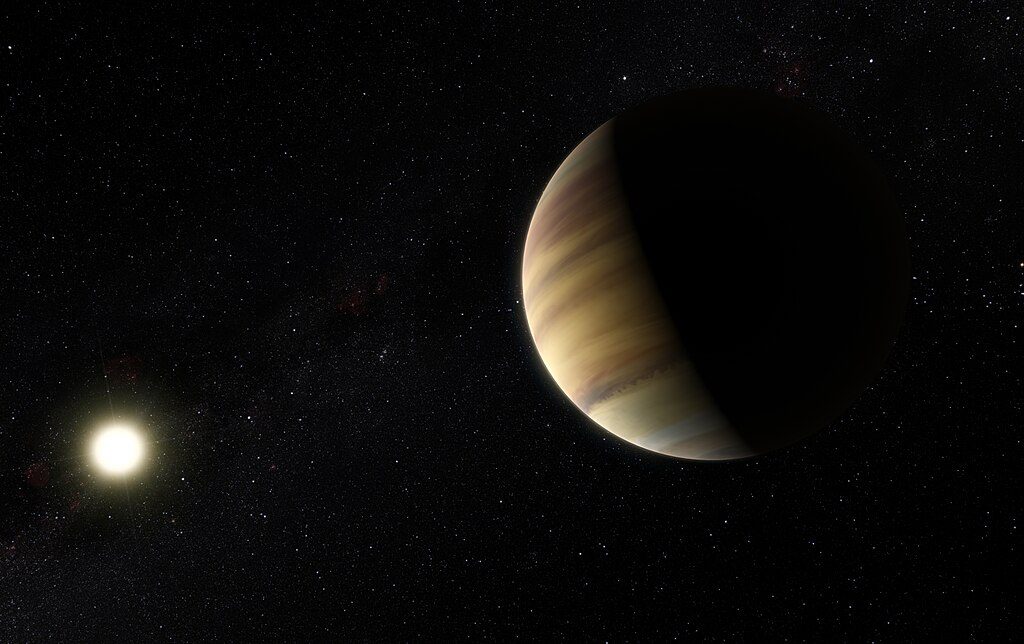
TOI-6883Ab is a Jupiter-sized gas giant with a mass comparable to or greater than Jupiter’s. What makes the planet particularly interesting is not its size, but its orbital shape. Rather than following a nearly circular path, TOI-6883Ab travels along an elongated orbit that brings it much closer to its star at certain points and much farther away at others.
This eccentric motion causes dramatic changes in the planet’s temperature over the course of a single orbit. When the planet swings close to the star, it experiences intense heating, while at its farthest point it cools significantly. These temperature variations offer a unique opportunity to study atmospheric responses to rapid heating and cooling.
The planet’s orbit suggests a turbulent past, possibly involving gravitational interactions with other planets or nearby stars.
A Planet Shaped by Gravitational Chaos
Highly eccentric orbits like that of TOI-6883Ab are often the result of gravitational disturbances. These can occur when multiple giant planets interact within a system or when a passing star disrupts planetary orbits during the system’s early history.
TOI-6883Ab may have been scattered into its current orbit after close encounters with other massive planets. Alternatively, it could be the survivor of a once-crowded planetary system where less stable worlds were ejected entirely.
Studying planets like TOI-6883Ab helps astronomers reconstruct these chaotic evolutionary pathways and understand how common such violent rearrangements are.
Why Eccentric Planets Matter
Most planets in our solar system follow nearly circular orbits, but exoplanet discoveries have shown that eccentric orbits are surprisingly common. TOI-6883Ab adds to the growing body of evidence that planetary systems often experience dramatic reshaping events.
Eccentric planets provide natural experiments for studying atmospheric physics. The rapid temperature changes experienced by TOI-6883Ab can drive extreme weather patterns, shock waves, and chemical changes in the atmosphere.
These planets also challenge traditional models of planet formation, which often assume smooth, orderly evolution.
Why TOI-6883Ab Is Big News
TOI-6883Ab is big news because it demonstrates just how extreme planetary orbits can become while still remaining stable over long timescales. Its discovery helps astronomers quantify how frequently giant planets occupy eccentric orbits and what that means for the rest of their systems.
The planet’s dramatic orbital variations make it an attractive target for future observational campaigns focused on atmospheric dynamics and orbital evolution.
TOI-6883Ab reinforces the idea that planetary systems are shaped by both formation and conflict.
What TOI-6883Ab Reveals About Planetary Systems
The existence of TOI-6883Ab suggests that calm, orderly systems like our own may be less common than once believed. Many planetary systems appear to undergo periods of instability that leave lasting marks on planetary orbits.
By comparing TOI-6883Ab to other eccentric exoplanets, astronomers can begin to identify patterns that reveal how these systems evolved.
What TOI-6883Ab Teaches Us About the Universe
TOI-6883Ab highlights the dynamic and often violent nature of planetary evolution. Its eccentric orbit stands as evidence that planets are not always born into stable, predictable environments.
As more eccentric giants are discovered and studied, TOI-6883Ab will help astronomers refine theories about how planetary systems survive chaos and settle into long-term stability.
Recent Articles Like This One