

TOI-7166 b: A Mini-Neptune in the Habitable Zone of a Nearby Star
Discovery and Detection of TOI-7166 b
TOI-7166 b recently made headlines as a newly validated mini-Neptune discovered by NASA’s Transiting Exoplanet Survey Satellite. Its significance stems from its location: it orbits within the habitable zone of its host star, where temperatures may allow liquid water to exist on a planet with suitable conditions. Although TOI-7166 b is likely a gaseous world, its discovery opens up intriguing possibilities for studying habitable-zone planets beyond our solar system.
The planet was first identified when TESS recorded periodic dips in starlight caused by the planet transiting its host star. Subsequent ground-based follow-ups confirmed its size, mass, and orbit. The combination of a mini-Neptune in a temperate orbit makes TOI-7166 b a rare find.
Size, Mass, and Orbital Characteristics
TOI-7166 b is classified as a mini-Neptune, larger than Earth but smaller than Neptune. Its composition is thought to include a rocky core surrounded by a thick gaseous envelope. The planet’s radius and mass indicate that it has retained a significant atmosphere, which could be studied in future observations.
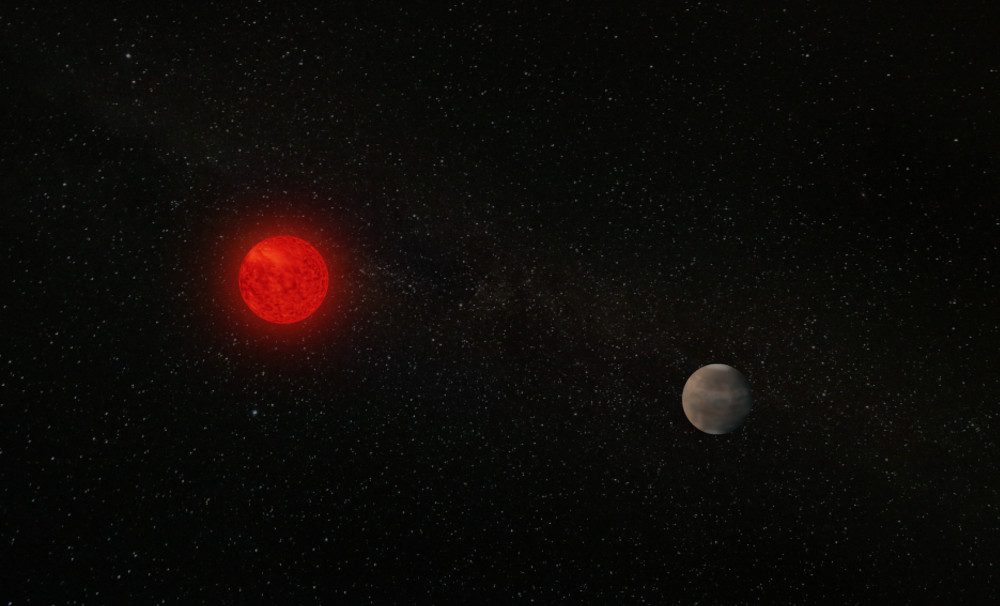
The planet orbits a low-mass star at a distance that places it in the star’s habitable zone. Its orbital period is moderate, resulting in stable conditions relative to planets closer or farther from their star. While its surface is unlikely to be solid, its atmosphere could offer clues about climate patterns, chemical composition, and potential habitability of similar planets.
Importance of Mini-Neptunes in Habitable Zones
Mini-Neptunes like TOI-7166 b are particularly important because they help bridge the gap between rocky Earth-like planets and larger gas giants. Their presence in habitable zones allows astronomers to study atmospheric retention, stellar radiation effects, and possible secondary processes that could support life on smaller moons or exomoons.
Studying TOI-7166 b also helps researchers understand how planets of intermediate size distribute themselves within planetary systems, including the frequency of habitable-zone mini-Neptunes.
Atmospheric Potential and Research Opportunities
TOI-7166 b’s size and proximity to Earth make it a prime candidate for future atmospheric characterization. Instruments such as the James Webb Space Telescope and upcoming ground-based observatories could analyze the planet’s atmosphere for water vapor, methane, or other compounds.
Understanding the chemical makeup of TOI-7166 b’s atmosphere can reveal whether similar planets might retain volatiles over long periods, an important factor in assessing habitability potential.
Why TOI-7166 b Is Big News
TOI-7166 b is big news because it represents a type of planet that is both common and scientifically valuable. Mini-Neptunes in habitable zones are rare among confirmed exoplanets, making each new detection an important addition to the catalog of nearby worlds.
The planet also highlights the continued success of TESS in uncovering exoplanets across a wide range of sizes, compositions, and orbital distances.
What TOI-7166 b Reveals About Planetary Systems
TOI-7166 b shows that planetary systems can produce a diverse array of planets in stable, habitable-zone orbits. Its presence suggests that other mini-Neptunes may exist around similar stars, offering multiple opportunities for comparative study.
By observing the planet’s atmosphere, orbit, and interactions with its host star, astronomers can refine models of planet formation and evolution in temperate regions.
What TOI-7166 b Teaches Us About the Universe
TOI-7166 b emphasizes the diversity of planetary types and the complexity of planetary systems. It illustrates that habitable zones may host worlds with thick atmospheres rather than only rocky surfaces, expanding our understanding of where potentially life-supporting planets might exist.
As more mini-Neptunes are discovered, TOI-7166 b will remain a benchmark for studying the relationship between size, orbit, and atmospheric retention in exoplanets.
Recent Articles Like This One