

Chicago: A Love Letter to the Windy City’s Quirks and Quarks
Chicago: The City That Never Sleeps… Because It’s Too Busy Complaining About the Weather
Ah, Chicago, the city of broad shoulders, deep-dish pizza, and even deeper political scandals. Welcome to the Windy City, where the architecture is tall, the winters are long, and the locals are always ready with a witty one-liner about how much they love to hate their own city. But let’s dive into the rich tapestry of Chicago’s history and landmarks, because if there’s one thing Chicagoans love, it’s talking about their city—even if it’s just to complain about the weather.
The Birth of a City: From Fur Trade to Sky High Dreams
Chicago’s humble beginnings can be traced back to the early 19th century when it was nothing more than a small fur trading post. Fast forward a few decades, and the city became the epicenter of the Great Fire of 1871, which, ironically, led to the birth of the modern skyscraper. Because nothing says ‘rebirth’ like a city rising from the ashes—literally. The Great Fire may have burned down most of the city, but it also gave architects the perfect excuse to build taller and grander, leading to the birth of the Chicago School of architecture. So, thank you, Great Fire, for giving us the Willis Tower and the John Hancock Center—two buildings that are basically middle fingers to the elements.
The Magnificent Mile: Where Shopping is a Contact Sport
The Magnificent Mile, or ‘The Mag Mile’ for those in the know, is a stretch of Michigan Avenue that’s basically a shopping mecca. It’s where you can find everything from high-end boutiques to department stores that make your wallet weep. But the real gem here is the Chicago Water Tower, one of the few structures that survived the Great Fire. It’s a testament to the city’s resilience—or at least its ability to build things that can withstand a good old-fashioned inferno.
The Art Institute of Chicago: Where Culture and Confusion Collide
The Art Institute of Chicago is a treasure trove of artistic masterpieces, from ancient artifacts to modern marvels. It’s the perfect place to spend a rainy afternoon, pretending to understand abstract art while secretly wondering why a blank canvas is considered a masterpiece. But hey, who are we to judge? If the experts say it’s art, then by all means, let’s appreciate the blank canvas for what it is—a blank canvas.
Millennium Park: Where Cloud Gate and the Bean Go Hand in Hand
Millennium Park is home to the iconic Cloud Gate, affectionately known as ‘The Bean.’ It’s a giant, shiny bean-shaped sculpture that has become the city’s most photographed landmark. It’s also a great place to people-watch, as tourists from all over the world gather to take selfies with the bean, completely oblivious to the fact that they’re standing in front of a giant, shiny bean.
The Chicago Riverwalk: Where Nature and Urban Life Collide
The Chicago Riverwalk is a beautiful stretch of walkway along the Chicago River, offering stunning views of the city’s architecture. It’s the perfect place for a leisurely stroll, a romantic walk, or a quick escape from the hustle and bustle of the city. Just be sure to time your visit right, because nothing ruins a romantic moment like a passing boat causing a mini tsunami.
The Museum Campus: Where Science, History, and Nature Collide
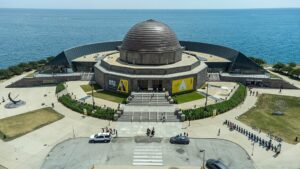
The Museum Campus is home to three of the city’s most renowned museums: the Field Museum, the Shedd Aquarium, and the Adler Planetarium. It’s the perfect place to spend a day learning about natural history, marine life, and the mysteries of the universe. Just be sure to wear comfortable shoes, because walking from one museum to the next is like running a marathon—except with more dinosaurs and less sweat.
The Chicago Architecture Center: Where Buildings Come to Life
The Chicago Architecture Center is a must-visit for anyone interested in the city’s architectural heritage. It’s home to a vast collection of models, photographs, and drawings that showcase the evolution of Chicago’s skyline. It’s also a great place to learn about the city’s most famous architects, like Louis Sullivan and Frank Lloyd Wright, who basically invented the concept of ‘form follows function’—or at least that’s what we tell ourselves to justify our love of modern design.
So there you have it, a whirlwind tour of Chicago’s history and landmarks. It’s a city of contrasts, where the old meets the new, and the past collides with the present. It’s a city that’s always evolving, always changing, and always ready with a witty one-liner about the weather. But despite its quirks and quarks, Chicago remains a city that’s full of life, full of energy, and full of surprises. And if there’s one thing we know about Chicago, it’s that it’s a city that never sleeps—because it’s too busy complaining about the weather.
Recent Articles Like This One