
LTT 1445Ab: A Rocky Planet in a Nearby Triple-Star System

Discovery and Identification of LTT 1445Ab
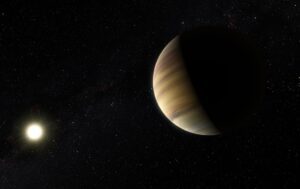
LTT 1445Ab has attracted attention because it orbits one star in a rare nearby triple-star system. The planet was discovered by NASA’s TESS mission, which observed periodic dips in the star’s brightness caused by the planet transiting across its host. Its proximity—just over 22 light-years from Earth—makes it one of the closest known transiting exoplanets, providing a unique opportunity for detailed study.
The triple-star system adds complexity and intrigue. LTT 1445Ab’s host star is part of a system where stellar gravitational interactions could influence the planet’s orbit. Despite this, the planet maintains a stable orbit, illustrating the surprising resilience of planetary systems even in multi-star environments.
Size, Mass, and Orbital Characteristics
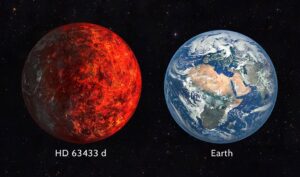
LTT 1445Ab is a rocky, Earth-sized planet with a radius approximately 1.3 times that of Earth. Its mass suggests a dense composition of rock and metal, confirming its classification as a terrestrial planet. This makes it particularly valuable for studies of small exoplanets beyond our solar system.
The planet orbits its host star closely, completing a full revolution in just over five days. While this proximity results in higher temperatures than Earth, the planet’s size and composition make it an excellent candidate for atmospheric characterization.
Its location in a triple-star system also provides a natural laboratory for studying how stellar companions influence planetary formation and long-term orbital stability.
Why Rocky Planets in Nearby Systems Matter
Rocky planets like LTT 1445Ab are prime targets for exoplanet research because they are small, solid worlds that could potentially host Earth-like conditions. Being relatively close to Earth makes LTT 1445Ab accessible for follow-up observations using space- and ground-based telescopes.
Its proximity also allows precise measurements of the star-planet interactions and the potential effects of stellar radiation from multiple stars. Studying LTT 1445Ab provides insights into how planets survive and evolve in multi-star environments.
Potential for Atmospheric and Habitability Studies
While LTT 1445Ab is likely too hot to be habitable, its size and composition make it an ideal target for atmospheric studies. During transits, astronomers can probe the atmosphere for gases, chemical composition, and potential signs of atmospheric loss.
Future observations may help determine how rocky planets retain atmospheres under the influence of multiple stellar companions, a question relevant to understanding planets in binary or triple-star systems.
Why LTT 1445Ab Is Big News
LTT 1445Ab is big news because it combines several rare features: a rocky, Earth-sized planet; a nearby location; and a host star that is part of a triple system. This combination provides a unique window into planetary formation and evolution under unusual conditions.
The discovery also underscores TESS’s capability to find small planets around nearby stars, which are the most promising targets for detailed study and potential characterization in the future.
What LTT 1445Ab Reveals About Planetary Systems
LTT 1445Ab demonstrates that terrestrial planets can form and maintain stable orbits even in complex, multi-star systems. Its discovery challenges assumptions that small planets are unlikely to survive in dynamically challenging environments.
By studying LTT 1445Ab and its neighboring stars, astronomers can gain insights into the formation, evolution, and stability of planets under gravitational influence from multiple stellar companions.
What LTT 1445Ab Teaches Us About the Universe
LTT 1445Ab illustrates the diversity of exoplanetary systems in our galactic neighborhood. Its existence proves that rocky planets can thrive in unexpected settings, expanding our understanding of where Earth-sized planets can exist and how common they may be in the Milky Way.
As one of the closest Earth-sized exoplanets discovered, LTT 1445Ab will remain a benchmark for studying the formation and evolution of rocky planets in multi-star systems.
Recent Articles Like This One